October 06, 2026
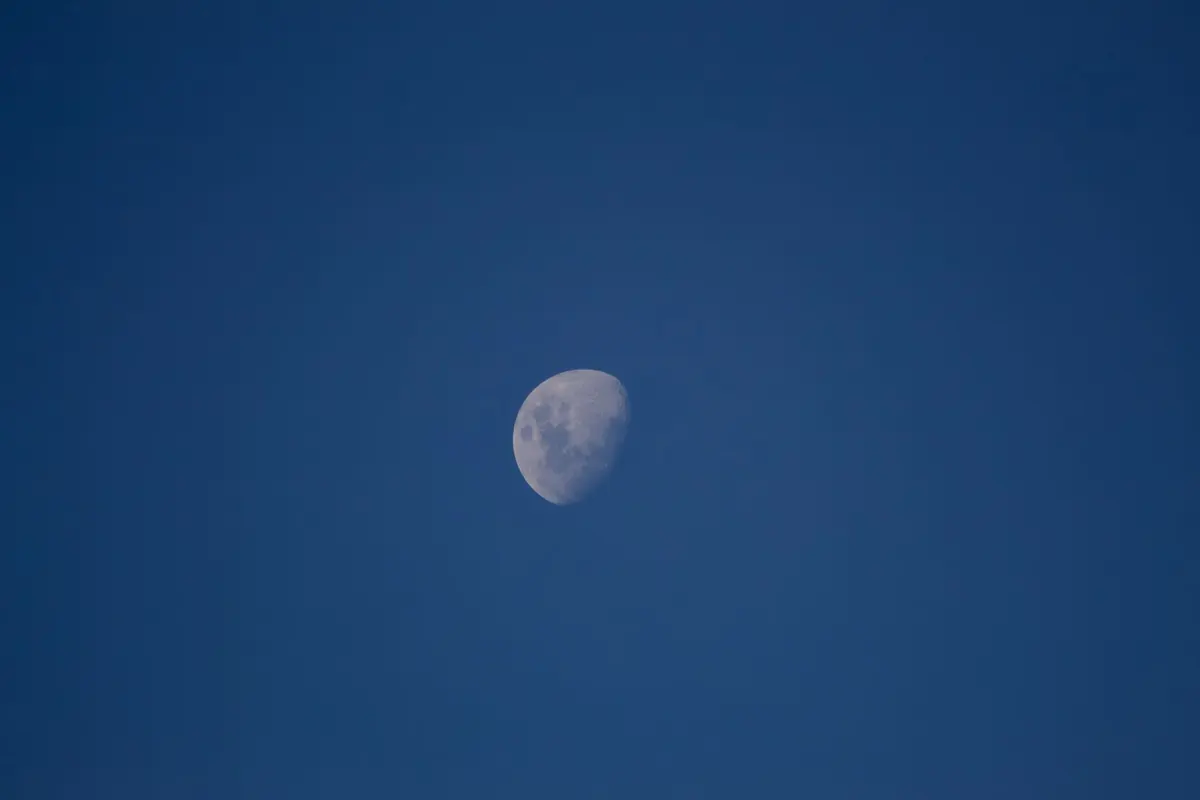
Step outside on a clear morning and look up. There it is: a pale disc hanging in blue sky, easy to miss beside a cloud or a contrail. People still stop and ask why. The Moon belongs to the night, the old shorthand goes—so what is it doing up there with the Sun? The answer is not mysterious. It is sunlight, geometry, and the fact that the Moon keeps its own schedule. Once you see the pattern, a daytime Moon becomes one of the easiest sky events to predict.
The Short Answer: Sunlight and Geometry
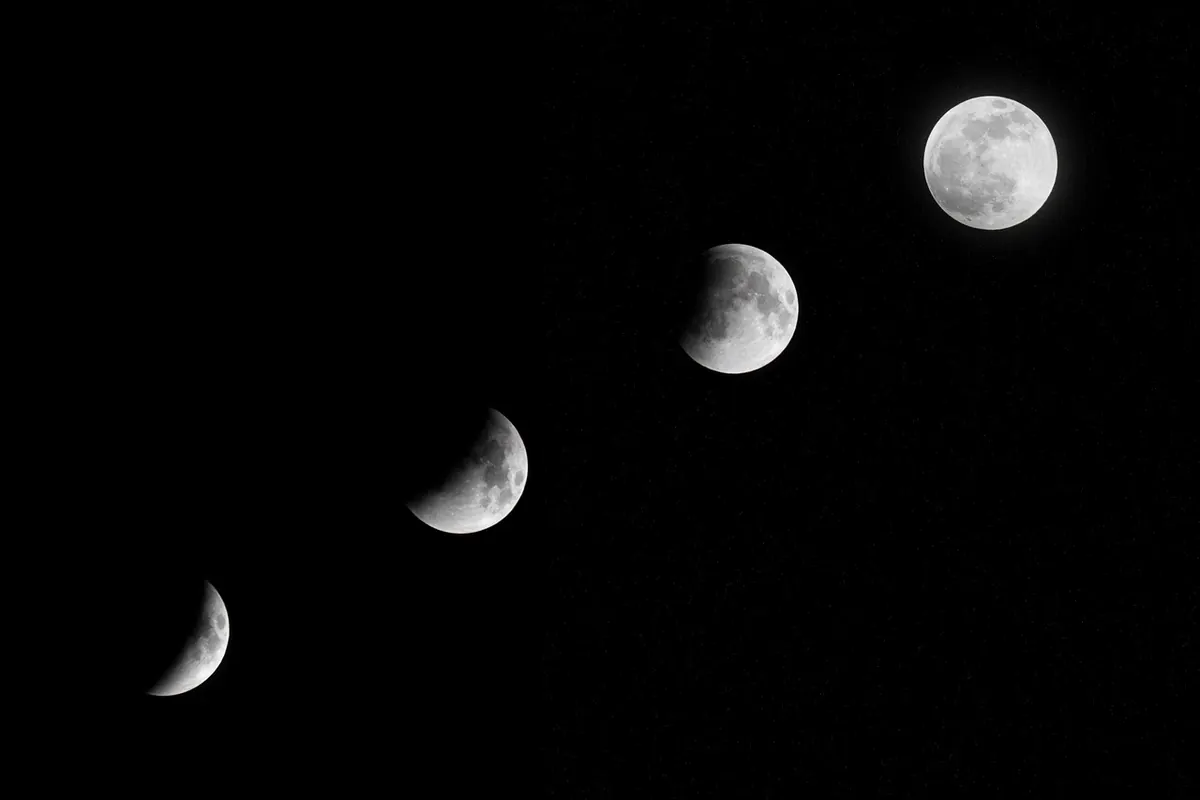
The Moon does not make its own light. It reflects sunlight, and at any moment half of its surface is lit and half is in shadow. What changes is how much of that sunlit half faces us. That is what we call phase: not the Moon's shadow, but our viewing angle.
Picture the Sun, Earth, and Moon as three points in space. When the Moon is between Earth and the Sun, the lit half faces away from us—new moon. When Earth is between the Sun and the Moon, the lit half faces us—full moon. In between, we see a crescent, quarter, or gibbous shape. The line between light and dark on the Moon is called the terminator, and it is a clean edge because the Moon has almost no atmosphere to soften it.
The Moon is above the horizon for roughly half of every day. The catch is that its twelve hours of visibility do not always line up with the Sun's. Near full moon, the Moon is up mostly at night. Near new moon, it is up mostly during the day, but it sits close to the Sun and is lost in glare. Between those extremes, there are many days when the Moon is above the horizon while the sky is bright. That is your daytime Moon.
Why It Looks Pale and Easy to Miss
Daytime moonlight has to compete with a bright sky. Sunlight scatters off air molecules and dust, filling the sky with blue light. The Moon's surface is not a polished mirror; it is dark gray rock and dust. At night it looks brilliant because our eyes adapt to darkness. In daylight, the same surface can look washed out, especially when the Moon is low and its light passes through more atmosphere.
Contrast is the key. A daytime Moon is usually easiest to see when it is fairly high, when the air is clear, and when the phase is not a thin crescent. A first-quarter Moon in the afternoon can look like a small white plate. A waning crescent in the morning is fainter and closer to the Sun, so it takes more care. Binoculars help, but never point them anywhere near the Sun. Even without optics, you can often find the Moon by looking away from the Sun's glare and scanning slowly.
A Beginner's Map to Phases and Times
You do not need an app to start, though one can help. Learn two anchor phases: first quarter and last quarter. They are the reliable daytime appearances.
Waxing Moon: Afternoon and Evening
- Waxing crescent: A thin Moon east of the Sun. It sets after sunset, so look low in the west after sundown. In daytime it is a late-afternoon target, low and close to the Sun's glare.
- First quarter: Roughly a week after new moon. It rises around midday, stands high in the afternoon, and sets around midnight. This is the classic afternoon Moon.
- Waxing gibbous: Rises in the afternoon and is visible before sunset, often high and bright. It sets after midnight.
Around Full Moon
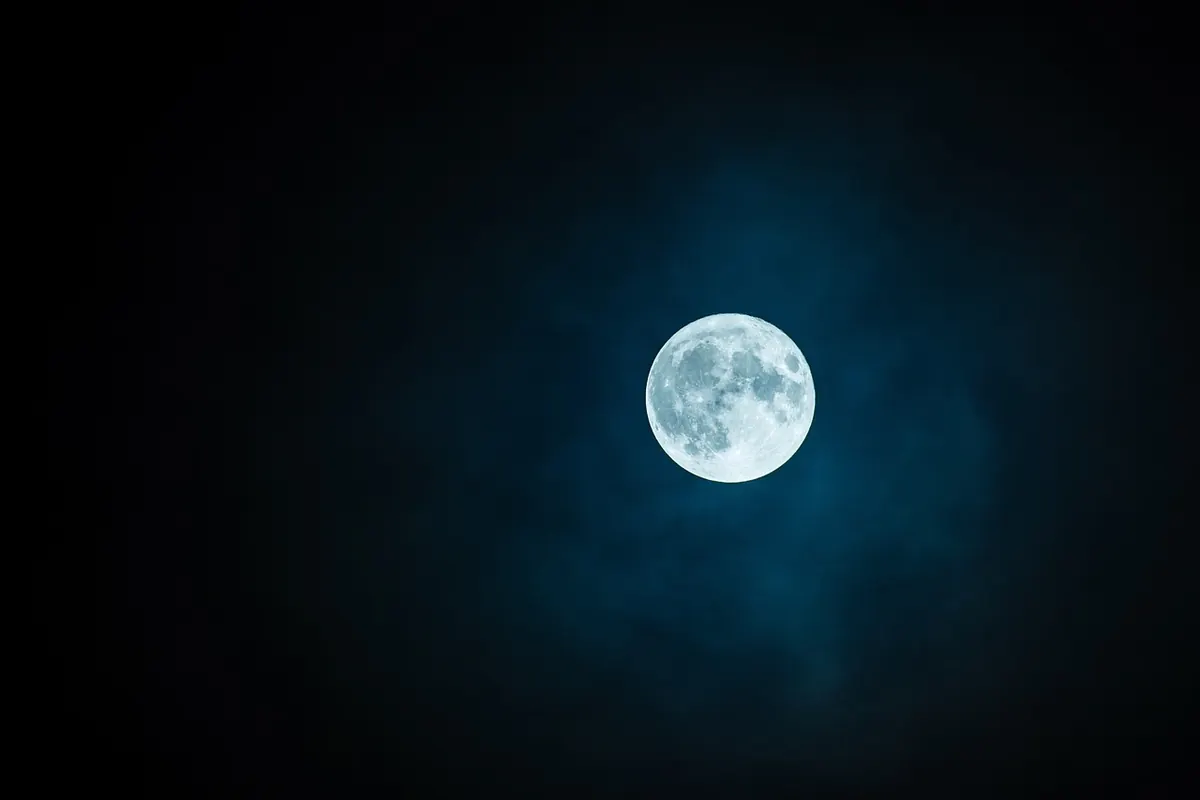
Full moon rises near sunset and sets near sunrise. It is mostly a night Moon, though you can catch it low near the horizon around dawn or dusk.
Waning Moon: Morning and Pre-Dawn
- Waning gibbous: Rises after sunset and sets after sunrise. Look for it in the western morning sky.
- Last quarter: Rises around midnight, stands high at sunrise, and sets around noon. This is the classic morning Moon.
- Waning crescent: Rises before the Sun and sets before or around midday. It is a pre-dawn and early-morning sight, low in the east.
Directions depend on where you live and the season. In the Northern Hemisphere, the Moon generally arcs across the southern sky. In the Southern Hemisphere, it arcs across the north. The phase times stay the same; the compass directions shift.
Folklore Misconceptions, Cleared Up
Lunar folklore is full of useful observations and a few stubborn errors. Here are the ones that come up most when a daytime Moon surprises someone.
“The Moon only comes out at night.” It does not. The Moon is a world in orbit, not a lamp on a timer. It is up during the day about as often as it is up at night, just less noticeable.
“The Moon's phases are caused by Earth's shadow.” This is the most common mix-up. Earth's shadow on the Moon is a lunar eclipse, which happens only at full moon and only occasionally. Ordinary phases come from our changing view of the Moon's sunlit half.
“A daytime Moon means the Moon is closer or larger.” The Moon's apparent size does not jump because the sky is blue. It can look bigger near the horizon—the Moon illusion—but that is a trick of perception, not distance.
“The far side is the dark side.” The Moon is tidally locked, so one face turns toward Earth. The far side gets plenty of sunlight; we simply do not see it from home. “Dark side” is a nickname, not a permanent shadow.
“A daytime Moon is a sign of bad weather.” Weather lore likes a rhyme, but the Moon's phase does not reliably predict rain or frost. It is a sky clock, not a forecast.
How to Spot the Daytime Moon: A Simple Practice
Try this on a clear afternoon near first quarter, or a clear morning near last quarter.
- Check the phase first. A calendar or a simple moon-phase app will tell you whether the Moon is waxing or waning.
- Find the Sun without looking at it. Use shadows to judge its direction. The Moon will be roughly a quarter of the sky away from the Sun at quarter phase.
- Put a building, tree, or your hand at the edge of your view to block glare. Do not stare at the Sun, and never use binoculars near it.
- Scan slowly in the expected direction. The Moon may look like a faint cloud or a pale sticker. Once you catch the edge, the whole disc tends to pop into view.
- Try again an hour later. The Moon moves against the sky, and the changing contrast can make it easier or harder to see.
A notebook helps more than memory. Write down the date, time, phase, and direction. After a month, you will have your own map of when the Moon shows up in daylight.
What Earlier Sky-Watchers Saw
For most of human history, the Moon was a calendar and a clock. Farmers, sailors, and travelers watched its phases for tides, light, and timing. A daytime Moon was not a separate mystery; it was part of the same cycle. Many cultures told stories about the Moon's journey, and some linked its appearance to luck, weather, or the behavior of animals. Those stories are worth keeping as stories. The bare fact is simpler and just as satisfying: the Moon is a sunlit world, and we see it whenever our line of sight and its orbit allow.
A Small Sky Habit
The next time someone says the Moon is out of place, you can point to the phase and the clock. The Moon is not trespassing in the day sky. It is doing exactly what a sunlit sphere in orbit should do. Pick one clear afternoon this week, look for the first-quarter Moon, and note where it sits. Then try a morning near last quarter. Two observations will teach you more than a page of explanation, and you will start to see the daytime Moon as one of the sky's ordinary, reliable pleasures.
Photo: Juan Poblete / Pexels